I N T H E I R N A T U R E
Modern Landscape Painting around Guillaume Vogels
INTRODUCTION
« N’accepter pour maître que la nature »
In 1968, the Belgian art historian Philippe Roberts-Jones, then Chief Curator of the Royal Museums of Fine Arts of Belgium, published an essay entitled Vogels, le mal-aimé [“Vogels, the unloved one”] in which he tried to understand why Guillaume Vogels, by then widely recognised as one of the principal figures in the emergence of Belgian Impressionism, had never quite received the honours his importance seemed to warrant. The question was not new. Already in 1921, speaking at what was then the largest retrospective devoted to Vogels, the former Director-General of Fine Arts Ernest Verlant reproached Belgium and the Belgians for failing to honour their own artists as other nations did.
Vogels occupies an unusual place in the history of Belgian art. Generationally, he belonged to the world of Belgian Realism and to the landscape painters associated with Tervuren; artistically, however, he became a point of reference for the younger avant-garde gathered around Les XX. He stood between two generations and two conceptions of painting, absorbing the achievements of one while opening possibilities for the next. To understand his importance, one must therefore begin some decades before Les XX, with the transformation of landscape painting itself.
Across much of Europe, landscape painting played a central role in the emergence of modern art. Working outdoors and directly before nature challenged established academic practice, while the desire to record changing effects of weather, atmosphere and light encouraged greater speed and immediacy of execution. These developments would eventually form much of the basis on which Impressionism built its pictorial language, but they had begun much earlier and assumed different forms in different countries.
Following Belgian independence in 1830, the young country was in search not only of a history, but also of a territory through which it could recognise and represent itself. While monumental history painting supplied the new state with heroes and founding myths, landscape gradually provided it with a visual geography. The valleys of the Meuse, the vast plains and heathlands of the Campine region, the wooded surroundings of Brussels and Tervuren, and eventually the dunes and shores of the North Sea came to constitute a repertory of recognisably Belgian landscapes. Repeated at the triennial Salons and international exhibitions, these views helped transform the geographical territory of the new state into an image of the nation.
Among the painters who prepared the ground for the profound changes that followed, Théodore Fourmois occupies a central, and today somewhat overlooked, position. This was not always so. By the middle of the nineteenth century, Fourmois was recognised as Belgium's leading landscape painter and exerted considerable influence upon a younger generation of artists. Particularly admired were his esquisses, or oil sketches, in which landscape was increasingly allowed to exist without narrative justification. Painted directly from nature and handled with a freedom very different from the carefully finished academic landscape, these works gave value to immediacy, observation and the visible act of painting itself. Independent in outlook and openly resistant to academic convention, Fourmois came to occupy an important place in Belgian accounts of the road towards Impressionism.
To describe Fourmois simply as a precursor of Impressionism, however, risks reading his achievement too exclusively through what came afterwards. His importance lies rather in the freedoms he helped make possible. The landscape study, the direct encounter with the motif and the unfinished or apparently spontaneous surface could themselves carry artistic value. These principles would become increasingly important to the younger generation associated with Tervuren and, in a different and more institutional sense, with the Société Libre des Beaux-Arts.
At precisely the moment when European art was becoming increasingly international, critics also became preoccupied with distinguishing between competing national schools. In Belgium, landscape offered particularly fertile ground for such claims. The direct observation of nature practised by Realist painters could be presented not merely as an imported modernism, but as the continuation of what critics regarded as a native tradition of sincerity and empirical observation rooted in the country's Flemish artistic past. Camille Lemonnier and others went further, associating generous handling, dark tonalities and a certain ruggedness, with the soil, climate and even temperament of Belgium itself. Such claims belong to the nationalist and sometimes deterministic language of nineteenth-century criticism, but they reveal how closely landscape had become connected to questions of artistic identity. Landscape came to define not only what Belgium looked like, but what Belgian painting was imagined to be.
Towards an « interprétation libre et individuelle de la nature »
Founded in 1868, the Société Libre des Beaux-Arts gave collective form to many of the freedoms that had been developing within Belgian art. It has often been described retrospectively as a coherent Realist movement in open revolt against the academic establishment. The historical reality was more complex. Its members differed considerably in style, generation and artistic outlook, and many continued to participate successfully in the official Salons whose limitations they criticised.
Their own manifesto provides a more accurate definition of what united them. The Société Libre sought to welcome and defend manifestations of contemporary art arising from an «interprétation libre et individuelle de la nature», or rather, a free and individual interpretation of nature. It admitted all schools and professed respect for every originality. What united its artists was therefore less a common style than a common refusal of constraint. Their paradox was a distinctly modern one: they organised collectively in order to defend the right to remain artistically individual.
Nor did the Société Libre simply turn its back on the official art world. Its members continued to seek recognition at the triennial Salons while attempting to reform their juries and methods of display from within. At the same time, they developed independent exhibitions, periodicals and networks through which they could exercise greater control over the conditions in which their work was seen. The Société Libre consequently occupied a transitional position between the declining academic system and the increasingly independent world of artists, critics, exhibitions and dealers that would characterise modern art.
Its exhibitions were particularly significant. Rather than the enormous accumulations of paintings characteristic of the official Salons, where works could cover the walls almost from floor to ceiling, the Société Libre experimented with smaller, more selective displays in which paintings were given greater visual independence. Modernity was beginning to concern not only what was painted, but also how paintings were seen and presented.
The Société Libre's first exhibition, held in December 1868, was remarkable for another reason: it consisted largely of études and esquisses. What academic practice had traditionally relegated to the preparatory stages of painting was presented in its own right within a serious exhibition. The sketch, defined by its immediacy, visible touch and proximity to the first encounter with the motif, was gradually acquiring the status of an autonomous work of art. In this respect, the freedom found in the esquisses of Fourmois was part of a much broader transformation of pictorial values.
His appearance at the Brussels Salon of 1851, where The Stone Breakers attracted considerable attention, had confronted Belgian artists with a powerful alternative to academic convention. Courbet's importance was not only pictorial. His ability to participate in official exhibitions while simultaneously cultivating the persona and networks of an independent artist offered a model for a generation attempting to negotiate between the Salon and an emerging free art market. It is therefore hardly surprising that the artists of the Société Libre elected Courbet an honorary member.
Its importance therefore lies less in having created a coherent school, or in having defeated the official establishment, than in the principles and practices it helped establish: artistic independence, greater freedom of exhibition and, above all, the legitimacy of individual expression.
Nature as their only master
The Société Libre des Beaux-Arts overlapped closely with another phenomenon that would acquire an almost legendary place in Belgian art history: the so-called School of Tervuren. Here again, the word “school” should be approached with caution. There was no academy, common doctrine or formal membership. It is more useful to understand it as one of the earliest and most influential informal concentrations of landscape painters in Belgium, approaching what would later be understood as an artists' colony: a loose circle of artists working in and around Tervuren during the 1860s, brought together by friendship, shared practice and a desire to work directly from nature.
The origins of the name are revealing. The regulations of the Brussels Salon of 1866 invited participating artists to state the name of their master or the academy in which they had studied. According to the accounts, some painters gathered at the Auberge du Renard in Tervuren responded with a joke: why not call themselves the École de Tervueren? Hippolyte Boulenger and Jules Raeymaekers duly entered the name in the exhibition catalogue. Yet the joke contained more truth than they may have intended. For these artists there was, in effect, no master but nature itself.
Nor was Tervuren the single birthplace of this development. The Campine region, the valleys of the Meuse and Lesse, the Sonian Forest and the North Sea coast all became places where artists gathered and worked. Other concentrations of landscape painters emerged elsewhere in the country, notably at Anseremme, near Dinant, and Genck in the Campine region, often centred on particular inns and lodgings that provided artists with food and shelter. Belgian landscape modernity as such did not coalesce around one privileged site; rather, a series of intensely local landscapes became laboratories for new ways of seeing, visited by constantly changing groups of artists sharing the same ideals.
This also explains the close overlap between Tervuren and the Société Libre. Almost all the painters later associated with the former moved within the orbit of the latter. The two should therefore not be understood as successive schools. Tervuren represented primarily a place, a practice and a network of friendships, while the Société Libre provided an organisational, institutional and critical framework through which a broader principle of artistic freedom could be defended.
Together, they contributed to a profound change in Belgian landscape painting. The Campine region, the Meuse, Tervuren, the Sonian Forest and the coast remained much the same territories through which an earlier generation had imagined the nation. What changed was the way those places were seen. Carefully constructed views increasingly gave way to immediate encounters with nature; anecdotal detail to atmosphere; finish to touch; and the representation of a place to the record of a moment experienced within it.
The landscape that had helped nineteenth-century Belgium imagine its national identity consequently became one of the principal fields in which its painters could question academic convention and formulate a modern art of their own.
From freedom to the avant-garde
The institutional transformation was equally gradual. When Camille Van Camp visited the fourth Impressionist exhibition in Paris in 1879, what impressed him was not only the paintings by Monet and company, but the existence of a supportive artistic milieu. Parisian artists, he observed with some frustration, were sustained by a community of “true artists” of a kind he felt impossible to establish in Brussels. Within only a few years, a younger Belgian generation would create precisely such an environment.
The disappearance of the Société Libre did not leave a vacuum. La Chrysalide, founded in the mid-1870s, brought artists of different generations into unusually close contact. Among them were Félicien Rops, Louis Artan and Guillaume Vogels, alongside younger figures who would soon occupy the forefront of Belgian modernism. Such societies are best understood not as a clean succession of stylistic schools but as overlapping networks through which artists met, exhibited and exchanged ideas.
Guillaume Vogels was something different: although born in 1836 and belonging by age to the preceding generation, he was not merely invited by Les XX. He was one of them; a founding member. For the younger generation, no older painter more completely embodied the artistic freedom they wished to claim for themselves.
Guillaume Vogels
By the time Vogels emerged as a mature painter in the 1870s, many of the decisive freedoms had already been won. Landscape no longer required narrative justification as a serious artistic subject. The sketch had acquired artistic legitimacy. Direct observation had become a virtue rather than a deficiency. The right to individual interpretation had been articulated as a principle. From Fourmois to Boulenger and the painters associated with Tervuren, and through the freedoms defended by the Société Libre, nature had become both subject and master. What remained was to carry that freedom into painting itself.
In Vogels’ work, the free interpretation of nature increasingly becomes a freedom of paint. Form loosens; matter thickens; colour assumes a greater autonomy; contours dissolve under snow, rain, mist or fading light. The distinction between the thing observed and the act of painting it begins to blur. Landscape is no longer merely represented: it is translated into paint as sensation.
Vogels had an unusual advantage. Largely self-taught as a painter, he had not undergone the sustained academic formation that shaped many of his contemporaries. He therefore possessed neither an academic method to unlearn nor an academic career to defend. His development was correspondingly difficult to contain within established categories, and made his painterly and artistic freedom even more difficult for the public to accept. Recalling Vogels' first appearances at Les XX, Verhaeren remembered the scandal they provoked. His paintings had been declared «impossibles, faites au balai» : impossible pictures, supposedly painted with a broom and likened to the work of house-painters and poster-pasters. What Verhaeren admired in retrospect was precisely Vogels' refusal to compromise : he had « jamais atténué son art ». The public eventually came to Vogels; Vogels did not come to the public.
Generationally he belonged to the world of Tervuren and Belgian Realism; aesthetically he became a point of departure for artists associated with Les XX. Moreover, his open association with the young avant-garde made an easy target of the daring artist, who was subsequently and forcefully side-lined by the establishment. Verhaeren records, for example, a Salon jury admitting only one of Vogels's submissions and placing it so high that it was barely visible, while rejecting the others. This may help explain why his place in Belgian art has proved so difficult to define. He was neither simply a precursor nor entirely a member of the younger avant-garde. He stood between generations, absorbing the achievements of one and opening possibilities for the next; simultaneously a culmination and a beginning.
Willy Finch, Schlobach and Guillaume Van Strydonck belonged to this same younger milieu, within which contemporaries increasingly recognised a distinctly Belgian form of Impressionist painting taking shape. Outside of the academic year, these artists would hock together in shared studios, or visit each other on their respective home turfs. They would even dabble together on the same paintings, as in the stunningly abstract dunescape from the collection of Henri Van Cutsem, today at the Musée Charlier, which was signed both by Ensor and by Van Strydonck. All of them worked under the influence of the master Vogels. Yet it would be misleading to describe them as a school gathered obediently at Vogels' feet. Their importance lies precisely in the opposite. Like the generation of the Société Libre before them, they developed highly individual languages. Vogels offered not a formula to imitate but an example of how far individual interpretation could be taken.
The same forests, fields, streets, harbours and coastlines continued to be painted. What changed was the experience of them. In Vogels's mature work, motif increasingly yields to atmosphere, colour, touch and matter. The landscape remains recognisable, but representation is no longer its sole purpose. Painting itself has become the event.
Subsequent exhibitions repeatedly returned to this history, each reconstructing it somewhat differently: from Les Maîtres de la Société Libre des Beaux-Arts at the Palais des Beaux-Arts in 1932 and Réalisme et liberté at the Royal Museums of Fine Arts in 1968, to Robert Hoozee's landmark Het landschap in de Belgische kunst 1830–1914 in Ghent in 1980. More recent exhibitions devoted to the Société Libre and the painters of Tervuren have further complicated the familiar succession of schools and movements.
In Their Nature returns to this history from a slightly different perspective. Rather than treating Romanticism, Realism and Impressionism as a succession of clearly separated schools, it follows a painterly freedom that developed gradually through landscape: the freedom to choose nature as subject, to work directly before it, to value the sketch and the immediate sensation, to exhibit independently, and ultimately to allow individual perception to determine the language of painting itself.
The journey leads from landscape as place, through landscape as experience, towards landscape as paint.
At its centre stands Guillaume Vogels: neither entirely the end of one tradition nor simply the beginning of another, but the point at which the history of nineteenth-century Belgian landscape painting begins to merge with the history of the Belgian avant-garde.
Thomas Deprez

This was particularly true in Belgium, where landscape came during the nineteenth century to occupy something approaching the status of a “genre national”. The association had deep historical roots, or, rather, nineteenth-century artists and critics understood it as having them. Landscape had acquired an increasing degree of autonomy in Netherlandish painting from the sixteenth century onwards, with Joachim Patinir occupying a particularly important place in that history. Born in the region of Dinant, in present-day Belgium, and admired by Albrecht Dürer himself, Patinir was among the earliest painters to specialise in landscape as an autonomous pictorial genre. His origins in the Meuse valley later allowed him to be claimed, alongside Van Eyck, Bruegel and Rubens, as part of the ancestry of a Belgian national school whose origins were imagined to predate the nation itself.

Edmond Lambrichs captured something of this generation in his large group portrait of 1868, bringing together most of the founding members of the artists society: amongst others, Édouard Huberti, Camille Van Camp, Alfred Verwée, Constantin Meunier, Louis Dubois, Louis Artan, Félicien Rops, and Eugène Smits. The movement also found literary voices in L'Art Libre (1872–1873) and subsequently L'Art Universel (1873–1876), with Camille Lemonnier becoming one of the most influential critics associated with the defence of modern Belgian art. Gustave Courbet, who had already proven his profound affection for the Belgian landscape over a decade earlier, provided an important point of reference.
Edmond Lambrichs, Portrait des membres de la Société Libre des Beaux-Arts.
Royale Museums of Fine Arts of Belgium, Brussels, inv. 3352.

It was long tempting to narrate the end of the Société Libre as a victory: by the middle of the 1870s, so the story went, its objectives had supposedly been achieved and academic resistance had finally collapsed before the advance of modern painting. Charles Hermans' monumental À l'aube, one of the sensations of the Brussels Salon of 1875, was made to symbolise such a triumph. The archival record tells a less heroic story. The Société Libre had struggled financially for several years, lost members and ultimately ceased its activities in 1876.
Charles HERMANS, À l'aube, o/c, 1875.
Royale Museums of Fine Arts of Belgium, Brussels, inv. 2812.

Louis Artan, the undisputed master of the Belgian seascape, carried this commitment to direct experience to an almost literal extreme. He famously had a wooden studio erected among the dunes on the beach at Adinkerke (present-day De Panne), allowing him to observe and paint the changing conditions of the sea at close range. A rudimentary wooden barrack on poles, it stood just above the water line at high tide. Whether in Tervuren's forests or before the North Sea, nature was no longer merely scenery. It had become both subject and working environment.
Louis ARTAN, The artist's studio, o/c.
Collection Dugardyn Wouters, photo: MSK Gent.

That process reached a new level with Les XX. Founded in 1883 and opening their first exhibition the following year, the group provided Brussels with an independent and increasingly international platform for the most advanced artistic tendencies of the day. Impressionism, Neo-Impressionism, Symbolism and other experimental languages could coexist within the same exhibition culture. The magazine L’Art Moderne (1881-1914), and the influential literary figures associated with it, defended the interests of the avant-garde on all fronts. Just as leading modern artists from abroad were invited to exhibit alongside the Brussels avant-garde, established Belgian artists of an older generation could also participate as invited guests.
The distinction between membership and invitation is particularly revealing. From its first exhibition in 1884, Les XX invited established artists whom the younger generation admired, both Belgian and foreign. Rodin, Whistler, Liebermann, Sargent and Chase appeared alongside older Belgian figures such as Louis Artan, Félicien Rops, Jan Stobbaerts and Charles Van der Stappen. The following year brought Constantin Meunier and Xavier Mellery alongside Fantin-Latour, Raffaëlli, Mesdag, Mancini and P.S. Krøyer. These artists were honoured guests.
Illustration: Poster for the first exhibition of Les XX in 1884.
This is where Vogels becomes essential. The famous poet Émile Verhaeren, one of the most perceptive contemporary observers of the Belgian avant-garde, recognised in him not merely a precursor but a master. “Vogels est un maître,” he wrote in 1884; “il a sa patte et sa griffe.” What distinguished him was less the precise formulation of things than the intensity with which he translated their atmosphere into paint. “De rares paysagistes ont vu plus finement que lui,” Verhaeren observed: “Ses sites sont mouvementés de vent, de pluie, de neige. Une vie de nuages, de branches remuées, d’eau passante y circule. Les choses sont imparfaitement formulées. Qu’importe!” For Vogels, the landscape remained recognisable, but description was no longer its principal purpose. Weather, tone, touch and matter had become carriers of sensation. Verhaeren even recognised something specifically local in these autumnal and winter landscapes, swept by rain, wind and snow, describing them as « paysages du nord, très spéciaux à notre pays ».
Guillaume VOGELS, Ixelles, matinée pluvieuse, ca. 1883, o/c,
Royal Museums of Fine Arts of Belgium, Brussels, inv. 4466.
Guillaume VOGELS, Sketch for Ixelles, matinée pluvieuse, o/c,
Sold to private collection by Thomas Deprez Fine Arts in 2025.
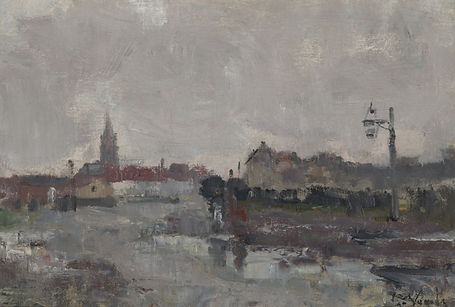


Among them, Hippolyte Boulenger came to embody the new landscape painting more completely than any other. Painters gathered in the wooded surroundings of Tervuren, outside Brussels, sketching and painting before the motif and submitting themselves to changing weather, atmosphere and light. Their practice formed part of a much wider European movement, and comparison with the French painters of Barbizon was inevitable. Several Belgian artists knew Fontainebleau and Barbizon at first hand. Yet Tervuren should not simply be understood as a Belgian offshoot of the French school. Similar aspirations towards direct observation, sincerity and freedom from academic convention developed within the particular context of Belgian painting.
Guillaume VOGELS, Portrait of Hippolyte Boulenger sketching in nature, o/c, 1873.
Collection of De Vrienden van de School van Tervuren vzw
Machelen, a short-lived artists colony
For the summer of 1883, Guillaume Van Strydonck rented a farmhouse in Machelen, then still a rural village on the outskirts of Brussels, as an inexpensive studio in which to work during the summer months. He invited his close friend and fellow student at the Brussels Academy, Jan Toorop, to join him there. The Symbolist painters Henry de Groux and William Degouve de Nuncques, likewise connected to the Brussels Academy, would later share a studio space there as well. Van Strydonck himself became increasingly attached to Machelen and eventually settled there on a more permanent basis.
The paintings he made in and around the village played an important part in his early submissions to Les XX and, consequently, in his early reception as one of the young voices in the development of Belgian Impressionism. At the first exhibition of Les XX in 1884, he centred his contribution on views of the cabbage field alongside his Machelen studio. These were followed by scenes drawn from everyday village life, such as Tireurs à l’arc au berceau of 1885 and the vibrant procession pastel of 1888. Nature, rural labour and village festivities alike provided Van Strydonck with subjects, and Machelen became a recurring testing ground for his developing art.
Although the circle that gathered there was relatively short-lived, Machelen earned its place in Belgian art history as a meeting ground for the young avant-garde, where artists worked in close proximity and experimented with new approaches to landscape, light and painting. It became one of several small but significant centres in the emergence of Impressionism in Belgium.
The connection with Guillaume Vogels is particularly revealing. One of his most daring paintings, Le Coup de vent, dated 1884 and among the highlights of the present exhibition, was painted at Machelen during a visit to the younger generation. Vogels, almost twenty years their senior, was therefore not simply an admired predecessor: he entered their environment and worked alongside them. The episode gives tangible form to the role he occupied between generations, linking the landscape tradition of the 1860s and 1870s with the young avant-garde of Les XX. Another Machelen painting by Van Strydonck, dedicated to his friend and fellow founding member of Les XX, the sculptor Paul Du Bois, is presented further in the exhibition.
Illustrations, from left to right:
Jan TOOROP, Machelen, ca. 1884. An oil sketch given by the artist to Guillaume Van Strydonck. Formerly in the collection of the Hearn Family Trust.
Guillaume VOGELS, Coup de vent (Machelen), 1884, o/c. Thomas Deprez Fine Arts, highlight of the present exhibition.
Guillaume VAN STRYDONCK, La maison du peintre à Machelen, 1886, o/c. Sold by Thomas Deprez Fine Arts in 2024.

His importance to younger painters was tangible. Before becoming one of the central figures of modern art in the Netherlands, the young Jan Toorop spent his formative years in Brussels, where he attended the Academy. Through La Chrysalide and later within Les XX, he came into close contact with Vogels and responded strongly to his vigorous facture and use of the palette knife. The portrait Toorop painted of Guillaume Vogels, exhibited at his first presentation with Les XX in 1885 and today held by the Royal Museums of Fine Arts of Belgium in Brussels, is particularly telling of his affection and admiration for the maître.
The friendship between Vogels and James Ensor, likewise some twenty years his junior, also left visible traces in Ensor's early landscapes and seascapes, whose atmospheric handling often invites comparison with that of the older painter. Discussing Ensor and Vogels together in 1884, Verhaeren recognised in both a similarly modern concern with colour and light, while distinguishing Vogels by « l'autorité du maître en plus ».